Say you decide to take your WW2-loving fiance out to see Fury for a date night movie.
Please be aware that this is not a horse-friendly movie. You will think all has passed when the opening scene features a horse who is treated well. It will not have passed. 3/4 of the way through is a horrible story about horses used to illustrate the barbarity of war.
Plus, it's an unsettling, disturbing, graphically violent movie - even more so, perhaps, than your typical WW2 action movie. Saving Private Ryan had more heart, but Fury has far more wanton cruelty, battle stress, and gore.
Consider yourself warned!

Bel Joeor: Life + Horses
Showing posts with label movie review. Show all posts
Showing posts with label movie review. Show all posts
Friday, November 7, 2014

Friday, October 3, 2014
Movie Review: Justin Morgan Had a Horse (1972)

(Available to watch instantly on Amazon and iTunes, or to buy on DVD on Amazon)
Let me be very explicitly up front and very clear before I delve into a review: this movie has little to nothing to do with either the actual historical events surrounding Justin Morgan and his horse Figure OR with the Marguerite Henry book of the same name.
If you want the historical review of the movie, I'll be posting one on Figuring History in the next few days, so keep an eye there.
In the meantime, let's do the horse-centric review of the movie. To that end, let me summarize the plot.
Justin Morgan is a schoolteacher and musician who travels to Massachusetts to settle a debt owed to him by his cousin. Said cousin died penniless, and the only things Justin receives are two horses and a cart. The younger of the horses is a small animal that Justin has named Figure.
The voiceover tells us that Justin Morgan Has a Dream: he wants to do something that will live on after him, something that really means something. Simultaneously, he wants to show the world a new way to train a horse. (Though at no point is there any explanation whatsoever of how his way of training a horse is different from any other way of training a horse, though at one point someone mentions that Justin wants to create an "all-around" horse that will do many different things...which is apparently a novel idea?)


(Please note that the character of Kathleen is entirely invented for the movie, and Joel Goss, Marguerite Henry's boy narrator, never appears.)
As Figure grows, he proves himself to be good at everything: hauling logs, racing in harness at the trot, and then racing under saddle at the gallop. Kids love him, and he's fearless. There's one particularly insane scene in which Figure hauls a log that no other horse could move, and then carries Justin Morgan and Robert Evans bareback down a quarry in a Man From Snowy River style scene in order to beat all the other loggers back to town.

Things finally come to a head, and Squire Fiske demands Figure in payment for Justin Morgan's debts. Justin sulks and decides to leave town, but then Fiske receives a challenge to race Figure against two New York horses. Justin agrees to stay and train Figure for the big race. If he wins, he gets Fiske to agree to let Kathleen out of the rest of her contract so they can get married.
The big race happens, and Figure wins! Surprise! Not only that, but Squire Fiske is so moved by Figure's devotion to Justin that he agrees to give the horse back to Justin in addition to letting Kathleen out of her contract. The epilogue scene of the movie shows that Justin, Kathleen, and Squire Fiske have all joined forces to create a new breed of horse.
So that's the summary. What about from a horse point of view?

With that in mind, a lot of other things are kind of weird. The way the horse is used in defiance of common sense. (That quarry scene comes to mind, holy crap.) For example, the log-pulling scene, which is a pivotal part of Figure's legend and Marguerite Henry's book, has been changed from a simple show of strength on Figure's part to a show of cleverness on Justin's - who has men sit on it so the front is lifted off the ground, and who has Figure move to unstick the log before pulling it.
Figure's pivotal race is also played up as Justin's cleverness. Figure is training well, but they need to make him faster, so Justin suggests that Robert Evans get up out of the saddle in a jockey crouch to stay off his back. (Duh?) He forges special ultra-light shoes himself. He trains the horse in all weather to be a stoic runner.
The really emotional moments of the movie are all centered on Justin, with Figure occasionally as a feature of those moments, but it's not about him. It's about Justin doubting himself, wanting to make a name for himself, trying to overcome odds. Justin doesn't so much believe in Figure as he believes in himself and the way he's trained Figure. Losing Figure is just one more setback in his life. He sulks a lot, but he's not truly devastated.
Training scenes are a bit bizarre. There's a training montage during which Justin longes Figure from yearling colt on up to two year old...and the horse improves not at all. He's a brat on the longe line through the whole montage. He just gets bigger and older. That big race that's the climax of the movie, that Justin trains Figure for? They have a week to train him. A. Week. Granted, the horse is fit already, but...really?

There's zero attempt to make tack even vaguely period - I'm pretty sure half the horses are just ridden in off-the-rack 1970s hunt saddles and flat bridles. The riding is piss-poor and there are some super-awkward scenes during the race when they try to get close-ups for tension. Buying oats for Figure is a central piece of Justin's debt to Squire Fiske, when the horse is on lush pasture 24/7.

That said, there's one thing they got very, very right. The horse they use for close-ups of Figure is a GORGEOUS example of a throwback, foundation Morgan. Just lovely. Many of the scenes with him really show that off. As best as I can tell, they use the same horse pretty much right through. Some of the action scenes it seems like they swapped in another random bay, but otherwise it's that same beautiful Morgan.
In final summation, this wasn't a terrible movie. It was perfectly engaging to watch, and at 91 minutes, relatively short. If you turn off the part of your brain that might know anything about history or Marguerite Henry's book, you'll probably enjoy it a fair bit. It doesn't have any glaring flaws, nor any glaring strengths. It's a perfectly enjoyable, somewhat bland little film.
Sunday, September 7, 2014
Movie Review: Dark Victory (1939)

(available on Amazon Instant)
The gist: Bette Davis plays heiress and playgirl Judith Traherne, who is diagnosed with a fatal brain tumor. She falls in love with her brain surgeon, played by George Brent. Geraldine Fitzgerald plays her best friend and secretary Ann, Humphrey Bogart plays her Irish horse trainer, and a very babyish Ronald Reagan plays her drinking buddy Alec.
On the surface, this movie is a melodramatic schlockfest in which Bette Davis reaches hysterical heights on a regular basis. It's considered a classic of its type.


Judith's horse Challenger is a central character in the movie, and a metaphor for Judith throughout. Trainer Michael (and oh, I could write an entire essay on Humphrey Bogart's terrible Irish accent) doesn't think the horse will ever amount to anything. Judith is convinced he's a champion. It's while taking him over fences at the beginning of the movie that she falls and is first diagnosed with her brain tumor. Michael brings Challenger to her bedroom while she's recovering, and his eventual admission that Challenger is a champion after all is another metaphor for Judith's acceptance of her diagnosis toward the end of the movie.
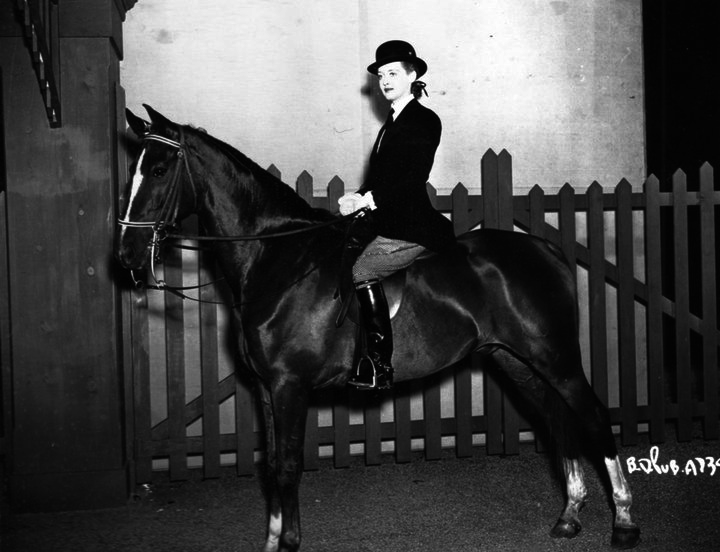

Incidentally, Bette Davis herself was something of a horse person, though perhaps not as deeply involved with the sport as her co-star in this film, Ronald Reagan, or other stars like Carole Lombard and Clark Gable. She renovated a home in New Hampshire named Butternut, and kept a horse there for her time off from moviemaking. I've also found mentions of horses she kept for her daughter as well.
Definitely recommended if you like classic film, and classic horse scenes.
Saturday, August 30, 2014
Justin Morgan Had a Horse (1972)
HELL YES this movie is on its way to me. Expect a review when it arrives. In the meantime, enjoy epically bad 70s hair pretending to be colonial.
Friday, January 24, 2014
Movie Review: The Horse Whisperer
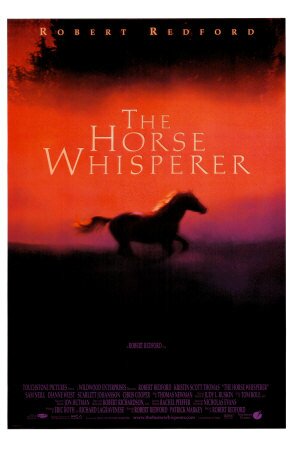
(available on Amazon to view instantly or to buy)
If you asked the average person to name a big Hollywood movie about horses, there are only a few that would come up. One of the few is The Horse Whisperer, based on the Nicholas Evans novel of the same name.
The gist of the plot is that a young girl named Grace (a very young Scarlett Johannsen!) and her horse get into a horrific accident. Both are badly injured both mentally and physically. Grace's mother (Kristin Scott Thomas) brings her and her horse, Pilgrim, to a "horse whisperer" (Robert Redford) who will try to heal them.
On one level, this is actually a pretty good movie. It's absolutely gorgeously shot, and the acting is outstanding. The emotions of all the characters are keenly portrayed and felt, and it's a good human story.
On another level? The horsemanship in this movie is absolutely batshit insane.
 |
| SO MANY BAD DECISIONS. |
After that is where it flies off the hinges. Because, you see, Grace's mother refuses to put Pilgrim down, even though his injuries are truly awful, and everyone with actual horse experience advises her to put him down. As a horse person, it made me instantly loathe her, because everyone advising her was right: she was putting the horse through incredible amounts of suffering just so she wouldn't have to make a decision. As Pilgrim is recovering, he becomes a dangerous, unpredictable animal.
The movie then posits that the horse's recovery and Grace's recovery are linked, somehow. So they pack poor Pilgrim up and drive him cross-country to see the horse whisperer Tom (in a stock trailer that they haul from Long Island to Montana without, apparently, ever stopping to water or feed the horse...or check on it...since the idea is that no one can even touch Pilgrim, he's so crazy).

There is also a typical movie ending: Pilgrim passes through crisis after crisis but after one final crisis in which he is roped and brought down by Tom, he magically becomes precisely the horse he was before the accident. Grace rides him around the ring perfectly and everyone looking on sheds a single, crystalline tear. It is a wildly inaccurate and borderline dangerous portrayal of what natural horsemanship can accomplish, and how to behave safely around a traumatized animal.
But then again, Robert Redford looks damn fine on a horse.
Friday, January 10, 2014
Movie Review: Danny
Danny (1979)
(available for purchase on Amazon.com, or instant through Netflix or Amazon Prime)
 This could have gone wrong in so many ways, and yet, ultimately it turned out right. It has the cliches in abundance: the poor girl who really cares about horses versus the rich girl who only cares how she looks, the talented yet broken pony, the Big Show, the mid-movie horse health crisis, you name it.
In the end, it's a really sweet movie, and it really gets the horse stuff on a good level. It refrains from over-explaining, which means that it avoids the pitfalls of getting the nitty gritty details wrong, and in its generalities it rings true.
 In short: Janie is a young girl who loves horses, and lives next to Longue Vue (yes, really) Stables, owned by her rich neighbor, apparently as his private farm. Neighbor's daughter Andrea rides because daddy expects it, and doesn't really "get" horses. Danny is the horse that was supposed to be Andrea's next champion hunter, but is sensitive and ends up injuring a tendon, and so becomes Janie's.
You already know the plotline of this movie from a thousand other horse stories, but it's the way the movie treats everyone involved and especially takes its horses seriously, that really make it sing. That, plus the long, loving shots of 1970s fashion and horse equipment. Trust me, it's great.
This was also reviewed by Horse Nation and by Lauren at She Moved to Texas, if you'd like other opinions.
(available for purchase on Amazon.com, or instant through Netflix or Amazon Prime)

In the end, it's a really sweet movie, and it really gets the horse stuff on a good level. It refrains from over-explaining, which means that it avoids the pitfalls of getting the nitty gritty details wrong, and in its generalities it rings true.

You already know the plotline of this movie from a thousand other horse stories, but it's the way the movie treats everyone involved and especially takes its horses seriously, that really make it sing. That, plus the long, loving shots of 1970s fashion and horse equipment. Trust me, it's great.
This was also reviewed by Horse Nation and by Lauren at She Moved to Texas, if you'd like other opinions.
Friday, December 20, 2013
Movie Review: Dreamer: Inspired by a True Story
Dreamer: Inspired by a True Story
(available for purchase on Amazon.com)
 You are a great champion. When you ran, the ground shook, the sky opened and mere mortals parted. Parted the way to victory, where you'll meet me in the winner's circle, where I'll put a blanket of flowers on your back.
Cale Crane and her family rediscover each other as they nurse a broken down racehorse back to greatness. It's a pretty standard plot: girl meets horse, horse is injured, girl believes in horse, horse proves girl right all along.
If Racing Stripes was the underdog race movie done wrong, Dreamer is that movie done right. They have more than their fair share of similarities; both fathers aren't following their dreams, both daughters find a connection with a horse (er, equine) that allows them to reconnect with their fathers, both duos prove everyone wrong.
The devil is in the details, though. This movie really is a loving homage to the horse racing industry, or at least a highly idealized version of it. (It is Hollywood, after all.) Many of the small things are just right, from the way Sonya's fracture is described to the guest appearances by Giant's Causeway and Fusaichi Pegasus, from the way Ben mixes up fly spray in a beat-up bottle to the realities of race entrance fees and the rivalry between two Middle Eastern brothers as they throw about huge sums of money. They even do a nice call-out to the "Inspired by a True Story" subtitle of the movie when they explicitly reference Mariah's Storm, her injury, and her return to racing.
 Sure, it tips too far into wish fulfillment at times, and sure, Cale is played a bit too cutesy especially as regards her ownership of the horse - sometimes her father's trusting of her reads less as parenting and more as abdicating responsibility - but it actually hits the right notes when it needs to. It also does the final race scene really, really well, which is harder to do than you would think (I'm looking at you, Secretariat).
In all, I'd definitely recommend it. It's a nice Sunday morning watch, it will hit the right sentimental buttons without getting too treacly, and enough of the horse details are right to keep a knowledgeable horse person in the movie.
(available for purchase on Amazon.com)
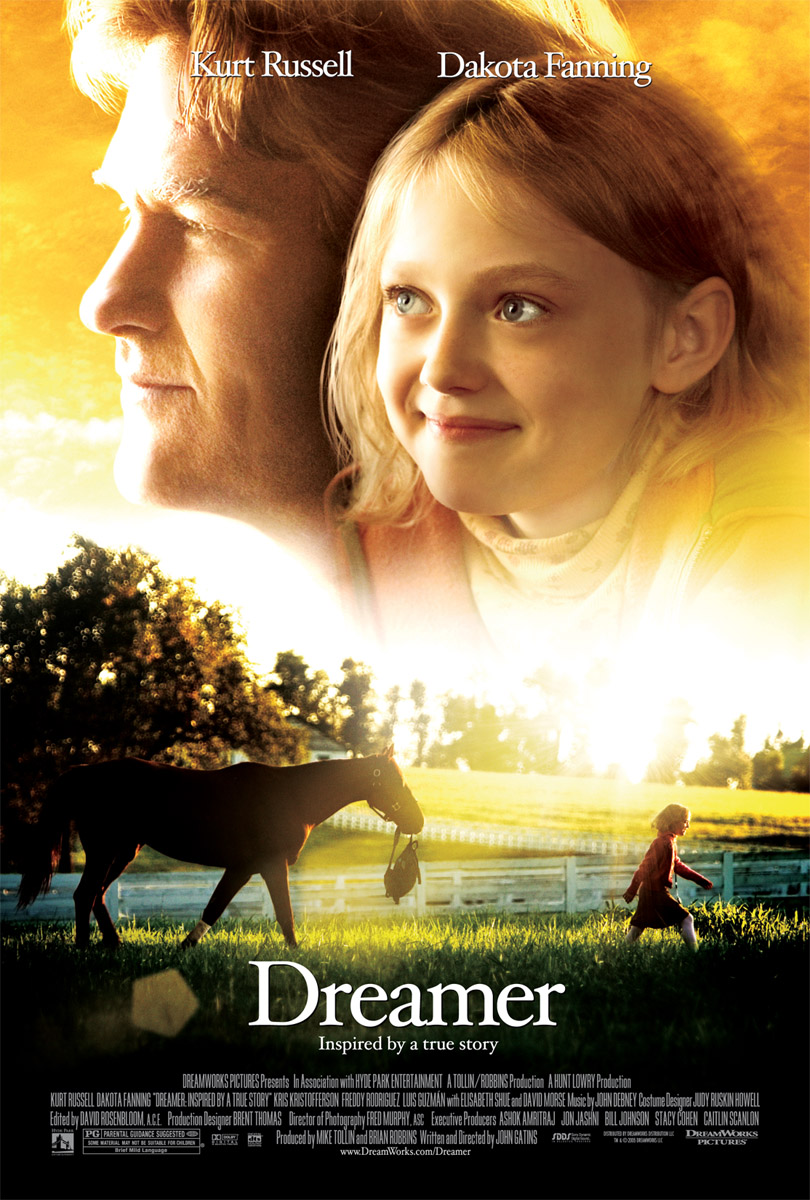
Cale Crane and her family rediscover each other as they nurse a broken down racehorse back to greatness. It's a pretty standard plot: girl meets horse, horse is injured, girl believes in horse, horse proves girl right all along.
If Racing Stripes was the underdog race movie done wrong, Dreamer is that movie done right. They have more than their fair share of similarities; both fathers aren't following their dreams, both daughters find a connection with a horse (er, equine) that allows them to reconnect with their fathers, both duos prove everyone wrong.
The devil is in the details, though. This movie really is a loving homage to the horse racing industry, or at least a highly idealized version of it. (It is Hollywood, after all.) Many of the small things are just right, from the way Sonya's fracture is described to the guest appearances by Giant's Causeway and Fusaichi Pegasus, from the way Ben mixes up fly spray in a beat-up bottle to the realities of race entrance fees and the rivalry between two Middle Eastern brothers as they throw about huge sums of money. They even do a nice call-out to the "Inspired by a True Story" subtitle of the movie when they explicitly reference Mariah's Storm, her injury, and her return to racing.
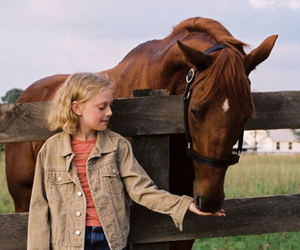
In all, I'd definitely recommend it. It's a nice Sunday morning watch, it will hit the right sentimental buttons without getting too treacly, and enough of the horse details are right to keep a knowledgeable horse person in the movie.
Friday, December 6, 2013
Movie Review: Racing Stripes
Racing Stripes (2005)
(available to rent or buy at Amazon.com)
 Whoo boy. I hit play thinking why not? This could be good cheesy fun.
I did not expect the sheer level of crack on display in this movie. I stopped counting or making notes of the ridiculous moments less than halfway through. There are just too many. The real heart of the problem, though, is that the movie can't agree on its own internal fantasy logic. Is this horse world or people world? Whyfor are the flies comic relief? Do horses behave like horses or like adolescents in horse clothing? So many questions.
If you haven't heard of this movie, the premise is that a zebra foal falls off the back of a circus truck and is raised on a Kentucky farm adjacent to a racetrack. He grows up thinking he's a racehorse. The father (Captain Pike from the new Star Trek movies, which was a fun little AU imagining for me) and daughter that raise him used to be in the racing business - he was the Best Trainer Ever - until the mother had an accident on a young horse and was killed. They have angst! But not enough angst to prevent them from doing insanely stupid things like, oh, hitching a zebra to a plow when he's never been handled...letting the girl ride him to work when he's never worn a saddle...training him for the Big Race in two weeks using a "gate" made out of two outhouses.
 But never mind that. A certain amount of magical realism is inherent in these things. This movie really tries to push it too hard, though. There's the human world, full of human reasons to win the race, and the horse world, complete with moonlight secret races and bizarro sexual politics and never the twain shall meet. Stripes could care less about his people; his people could care less about Stripes.
Anyway. I have a pretty high tolerance for cracktastic horse movies, and this one left me cold, bored, and disdainful rather than even lightly amused.
(available to rent or buy at Amazon.com)
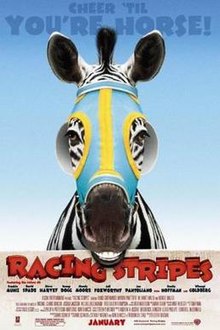
I did not expect the sheer level of crack on display in this movie. I stopped counting or making notes of the ridiculous moments less than halfway through. There are just too many. The real heart of the problem, though, is that the movie can't agree on its own internal fantasy logic. Is this horse world or people world? Whyfor are the flies comic relief? Do horses behave like horses or like adolescents in horse clothing? So many questions.
If you haven't heard of this movie, the premise is that a zebra foal falls off the back of a circus truck and is raised on a Kentucky farm adjacent to a racetrack. He grows up thinking he's a racehorse. The father (Captain Pike from the new Star Trek movies, which was a fun little AU imagining for me) and daughter that raise him used to be in the racing business - he was the Best Trainer Ever - until the mother had an accident on a young horse and was killed. They have angst! But not enough angst to prevent them from doing insanely stupid things like, oh, hitching a zebra to a plow when he's never been handled...letting the girl ride him to work when he's never worn a saddle...training him for the Big Race in two weeks using a "gate" made out of two outhouses.

Anyway. I have a pretty high tolerance for cracktastic horse movies, and this one left me cold, bored, and disdainful rather than even lightly amused.
Friday, November 22, 2013
Movie Review: White Mane
White Mane (1953)
(available on Netflix streaming, or for purchase on Amazon.com)
 This has been on my Netflix to-watch list for sometime, if only because at some point I did a search for "horse" and added everything I could.
At only 40 minutes, White Mane is a really sweet, lovely movie about a boy who befriends one of the wild horses of the Camargue in southern France. It is 95% without dialogue, and filmed in black and white in a more documentary style. In fact, the only sound at all is a light soundtrack and some sound effects that are more for imaginary effect than realism (a horse galloping through the water does not make the same noises as a person walking through a puddle, I'm just saying.)
It's very, very French, and filled with "don't try this at home, kids" moments - lots of scary, dangerous things done by everyone involved, from horses to kid to wranglers. It's somewhat nonsensical in its portrayal of the main character, the wild stallion White Mane, who is imbued with all the Black Stallion qualities you could hope for.
 In the end, though, it is almost compulsively watchable, incredibly gorgeous, and overall has a dreamy, fairy tale feel to it, even through the long chase scenes. I put it on as background while I caught up on some work at home, and couldn't stop watching.
The ending is...ambiguous and somewhat difficult and somewhat sad. If it tells you anything, this film is by the same director as The Red Balloon. You can choose to elevate the entire story to a fairy tale, and believe the narrator about the fate of the boy and his horse; that's what I'd recommend. The whole movie builds toward a more fantastical interpretation of its own events rather than a realistic one, so it works.
Definitely recommended. In fact, if I'd discovered this as a kid it would've been a top 10 for sure.
(available on Netflix streaming, or for purchase on Amazon.com)

At only 40 minutes, White Mane is a really sweet, lovely movie about a boy who befriends one of the wild horses of the Camargue in southern France. It is 95% without dialogue, and filmed in black and white in a more documentary style. In fact, the only sound at all is a light soundtrack and some sound effects that are more for imaginary effect than realism (a horse galloping through the water does not make the same noises as a person walking through a puddle, I'm just saying.)
It's very, very French, and filled with "don't try this at home, kids" moments - lots of scary, dangerous things done by everyone involved, from horses to kid to wranglers. It's somewhat nonsensical in its portrayal of the main character, the wild stallion White Mane, who is imbued with all the Black Stallion qualities you could hope for.

The ending is...ambiguous and somewhat difficult and somewhat sad. If it tells you anything, this film is by the same director as The Red Balloon. You can choose to elevate the entire story to a fairy tale, and believe the narrator about the fate of the boy and his horse; that's what I'd recommend. The whole movie builds toward a more fantastical interpretation of its own events rather than a realistic one, so it works.
Definitely recommended. In fact, if I'd discovered this as a kid it would've been a top 10 for sure.
Friday, November 15, 2013
Movie Review: Miracle of the White Stallions
Miracle of the White Stallion (1963)
(available on DVD at Amazon.com)
 In my world, there are only two perfect horse movies. I'll talk about the other one soon, but one is Disney's 1963 movie Miracle of the White Stallions, starring Robert Taylor as Colonel Alois Podhajsky.
Miracle tells the story of a very fraught period in the history of the Spanish Riding School: 1945, when the school was under Nazi reign and in a Vienna that was in constant danger. Podhajsky - arguably the school's greatest director, and one of the great dressage riders of the 20th century and perhaps of all time - persevered to save not only the school and its stallions, but also the mares and foals from the stud farm in Piber. It's based on Podhajsky's memoir My Dancing White Horses, which has been out of print for many, many years and which I would dearly love to read someday.
Make no mistake: this is a movie of its time. There are precisely two mentions of concentration camps; both are fleeting and neither acknowledges the Holocaust. There are Evil Nazis and there are Good Men Who Happen to Be Nazis. There are gosh-darn American GIs, the pacing is not the greatest, and let's not even talk about the gender politics, though the movie does actually pass the Bechdel Test and arguably Podhajsky's wife Vedena gets some of the film's best lines.
 Disney pulled out all the stops on this movie. It was filmed on location, using the actual SRS stallions and riders. Alois Podhajsky was Robert Taylor's stunt double. There are long segments that watch more like one of those old Disney nature documentaries than a feature film - long, sweeping, gorgeous shots of herds of beautiful horses, pleasant historical narration, and minimal plot for chunks.
It seems like someone involved with this movie also realized they were filming history in action: there are extended sequences of training and performance with the SRS stallions and riders, multiple examples of the Airs Above Ground, long, loving, sweeping views of the quadrilles. Transitions are flawless, and the concentration of the stallions is fierce and comes right through the screen. The movie, intended as a commercial success, has become a historic artifact.
 I can't be alone in my childhood obsession with this movie in particular and the Spanish Riding School in general. I rented and watched the VHS more times than could possible be counted, and when I wasn't watching the movie I was re-reading Marguerite Henry's White Stallion of Lipizza (which I am delighted to see is back in print, Christmas list ahoy!). As an adult, Podhajsky's Complete Training of Horse and Rider is my guiding star, one of the few training books that I hold dear to my heart and always find inspiring.
In short: be very aware of this movie's shortcomings, but don't tell me about any of them. Absolute perfection.
(available on DVD at Amazon.com)
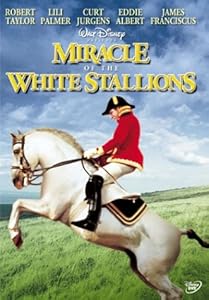
Miracle tells the story of a very fraught period in the history of the Spanish Riding School: 1945, when the school was under Nazi reign and in a Vienna that was in constant danger. Podhajsky - arguably the school's greatest director, and one of the great dressage riders of the 20th century and perhaps of all time - persevered to save not only the school and its stallions, but also the mares and foals from the stud farm in Piber. It's based on Podhajsky's memoir My Dancing White Horses, which has been out of print for many, many years and which I would dearly love to read someday.
Make no mistake: this is a movie of its time. There are precisely two mentions of concentration camps; both are fleeting and neither acknowledges the Holocaust. There are Evil Nazis and there are Good Men Who Happen to Be Nazis. There are gosh-darn American GIs, the pacing is not the greatest, and let's not even talk about the gender politics, though the movie does actually pass the Bechdel Test and arguably Podhajsky's wife Vedena gets some of the film's best lines.

It seems like someone involved with this movie also realized they were filming history in action: there are extended sequences of training and performance with the SRS stallions and riders, multiple examples of the Airs Above Ground, long, loving, sweeping views of the quadrilles. Transitions are flawless, and the concentration of the stallions is fierce and comes right through the screen. The movie, intended as a commercial success, has become a historic artifact.

In short: be very aware of this movie's shortcomings, but don't tell me about any of them. Absolute perfection.
Friday, November 8, 2013
Movie Review: International Velvet
International Velvet (1978)
(available on Amazon Instant for $2.99 rental)
 This past weekend, I rewatched International Velvet, which is one of my top five favorite horse movies of all time. It's the sequel to National Velvet. The movie begins with Sarah Brown, the daughter of Velvet's younger brother Donald, who was orphaned and comes to live with her aunt in England. They turn out to have a love of horses in common, and Sarah trains up the Pie's last foal to become an eventing superstar, cleverly named Arizona Pie.
This is the kind of movie that does some things really, really right and other things really, really wrong. I rather adore it, for its spirit if nothing else. It captures beautifully the ambition and hard work and joy of horses, and it is a fitting - if sad - sequel to National Velvet in its continuation of Velvet's story.
The things it gets wrong are the usual small silly things: the Pie has transformed from the book's piebald gelding, and even from the movie's chestnut gelding, to a seal bay stallion. He also has to be at least 40, by the universe's internal chronology, and...yeah, no. Some of the details of horsekeeping are just dumb. The cinematic conceit of making everything faster - stronger - scarier in regard to horses holds true; there's one extended chase sequence in particular that would be insanely dangerous and probably kill both Sarah and Arizona. (It still works, though; it's frightening and maddening in equal measure as intended, and the bad guys get a particularly awful comeuppance.)
 But oh, the things it gets right. Sarah is a bit of a stereotype, true, but she's the best kind of horse-crazy. Her relationship with Arizona is a little Black Stallion-y but it still works. The best part about her character is how terrible she is with people. In fact, she's not really very likeable. "I'm never going to be what people expect me to be," she confesses to an admiring boy at one point. "Don't feel badly. There's nobody else. It's just me."
The movie really gets eventing, right deep down, and it doesn't fall prey to the usual mistakes about the format of the sport that the handful of other movies about eventing do. In particular, the team selection bits are marvelous. There is a bit where the chef d'equipe explains the politics of team selection that is just perfect.
Possibly my very, very favorite thing about it is Velvet, and her adult life. Her relationship with John (Christopher Plummer in all his glory) is note-perfect in its characterization of a happy loving adult relationship. Her sadness and regret at the way her life turned out is poignant and painful. Remember her mother, who was afraid that swimming the Channel was the only big thing that would happen to her? Velvet, despite her protests, turned out much the same. After winning the Grand National, she stopped riding - she says she "lost her nerve" and later in talking about Sarah said, "All I hoped was, she wouldn't win too early, and afterwards have nowhere to go."
 My second favorite thing? Anthony Hopkins as Captain J.R. Johnson, the British chef d'equipe, who basically steals the entire movie from everyone else. He gets all the best lines and all the best scenes. It might be my favorite role of his. Here are just a very few of his selected quotes:
 Final warning: there is a scene on a plane that...well...it's quite frankly really horrible. If you don't deal well with animal death, fast forward any of the times they're on the plane, ok?` I do, every time.
In short: absolutely worth it, both as a horse movie and as an eventing movie. We'll just pretend the scene on the plane didn't happen onscreen, and ignore the stupid final resolution of Sarah's storyline.
(available on Amazon Instant for $2.99 rental)
 This past weekend, I rewatched International Velvet, which is one of my top five favorite horse movies of all time. It's the sequel to National Velvet. The movie begins with Sarah Brown, the daughter of Velvet's younger brother Donald, who was orphaned and comes to live with her aunt in England. They turn out to have a love of horses in common, and Sarah trains up the Pie's last foal to become an eventing superstar, cleverly named Arizona Pie.
This is the kind of movie that does some things really, really right and other things really, really wrong. I rather adore it, for its spirit if nothing else. It captures beautifully the ambition and hard work and joy of horses, and it is a fitting - if sad - sequel to National Velvet in its continuation of Velvet's story.
The things it gets wrong are the usual small silly things: the Pie has transformed from the book's piebald gelding, and even from the movie's chestnut gelding, to a seal bay stallion. He also has to be at least 40, by the universe's internal chronology, and...yeah, no. Some of the details of horsekeeping are just dumb. The cinematic conceit of making everything faster - stronger - scarier in regard to horses holds true; there's one extended chase sequence in particular that would be insanely dangerous and probably kill both Sarah and Arizona. (It still works, though; it's frightening and maddening in equal measure as intended, and the bad guys get a particularly awful comeuppance.)

The movie really gets eventing, right deep down, and it doesn't fall prey to the usual mistakes about the format of the sport that the handful of other movies about eventing do. In particular, the team selection bits are marvelous. There is a bit where the chef d'equipe explains the politics of team selection that is just perfect.
Possibly my very, very favorite thing about it is Velvet, and her adult life. Her relationship with John (Christopher Plummer in all his glory) is note-perfect in its characterization of a happy loving adult relationship. Her sadness and regret at the way her life turned out is poignant and painful. Remember her mother, who was afraid that swimming the Channel was the only big thing that would happen to her? Velvet, despite her protests, turned out much the same. After winning the Grand National, she stopped riding - she says she "lost her nerve" and later in talking about Sarah said, "All I hoped was, she wouldn't win too early, and afterwards have nowhere to go."

"Oh. Well. We wouldn't exactly call that riding, would we? Staying on a horse, perhaps. Where did you learn to ride?...Oh, in the colonies, yes. Well, that explains it. You realize, of course, that they don't allow cowboys in the Olympics?"
"No, no, no. Come on! Stop. Start again. This is dressage. It's meant to be like a ballet, Mr. Clark, not a barn dance, or like a pregnant Tom Mix. Don't ask me who Tom Mix was. It's all too long ago, and I can't remember. Now, once more and not with feeling. Please, spare me that."
"Some of you may have come here with the impression that dressage is frightfully boring compared to the greater glories of the cross country event. That's because you all lack sophistication, amongst other things.
Now, we come to the cross country event. The cross country event is considered by some, Miss Brown, to be an opportunity to display carefree abandon. This is a mistake for which I would cheerfully re-introduce capital punishment. This is a test of brains. And since horses are only marginally less stupid than some of the people who ride them, an observation which carries with it the experience of a lifetime, I would urge you not to sit on your brains, but to use them."
"Dressage in pouring rain is like dancing Swan Lake in clogs in a bog. The greater glory of the sport was somewhat obscured from view that day."

In short: absolutely worth it, both as a horse movie and as an eventing movie. We'll just pretend the scene on the plane didn't happen onscreen, and ignore the stupid final resolution of Sarah's storyline.
Friday, April 19, 2013
Movie Review: The Long Shot

The Long Shot (2004)
Okay. All right. Let's talk about this. Let's start with the poster: Arab-y looking thing in a poorly fitting halter, running freeeeee in the background behind a woman with her child in Western tack wandering along a ridgeline. Think about for a moment what kind of movie you would expect this to be, based on that poster. Imagine some plot and character details, setting, etc.
So now let me tell you that this movie is about a woman who rides dressage. She moves to California with her loser husband and her diamond in the rough Grand Prix horse, who promptly abandons her and her daughter to live in a motel. She gets a job working for a legendary trainer, mucking stalls, teaching lessons, etc., and overcomes a series of setbacks on her way to being the feistest, cleverest, horse whispering-est horse expert ever.
It's available on Netflix streaming, and while it is one of the most ridiculous movies I have ever seen (see below for a handful of non-spoilery things that actually happen) it is weirdly watchable. I rarely sit through full movies these days and I watched the whole thing. With lots of chocolate. And lots of incredulous texting to Hannah.
So let's go over just a very small, not even all that dramatic things that happen in this movie. Multiply all of these together by 10 and you will have the equivalent one of at least three major totally loony plot twists.
- They drive cross-country from Colorado to California with a horse in a trailer, and when they pull up to the motel she decides she'll take her horse for a ride, so she does. For, like, HOURS, judging by the movie's internal chronology.
- At one point, she starts riding the trainer's difficult horses in the middle of the night and then gets all huffy when the trainer is pissed off that she has done so, because clearly she's fixing everything, stop being mean!
- She and the loser husband use her (never shown, as far as I can tell) horse as collateral for the loan they have to take out to move across the country. She is surprised and deeply offended when the loan comes due, and writes a nice letter to the bank manager that will clearly solve everything. (Spoiler alert: it doesn't.)
It is amazing that this movie was written, filmed, edited, and then actually released. It is the very cheesiest kind of cheese, riddled with ridiculous horsemanship that has the veneer like they actually researched some of it - maybe they read a few articles on dressage at least halfway through, anyway.
Subscribe to:
Posts (Atom)